Unmanned Systems

PLASMA (FALCON) FLYER 1.11 / 6.6 - 8.0 kg MTOW
Electrofluidsystems is developing a novel swarm capable high-tech mini UAV with agile flight performance and the ability for high-altitude flights through active flow control and plasma anti/de-icing on wings and propeller. The PLASMA FLYER or SWARM FLYER is made of a laser-sintered, additive manufactured, ultra-strong PEEK structure with a prepreg composite hull and honeycomb core structure. This enables high speed, high g-forced starts from ultrashort pneumatic launchers.
  |   |
The world's first plasma flow controlled flying wing UAV has an improved performance at flight conditions which usually would stop other drones from flying because of strong crosswind induced flow separation and instability effects. The vehicles durability to crosswinds was increased by more than 60% and is thus higher than for other mini flying wing UAVs.
The high cruise speed and integrated plasma flow contol system makes the PlasmaFalcon system superior to existing flying wing drones. The sophisticated sliding discharge plasma actuators and generators were developed by our founder Berkant Göksel during his doctoral study at TU Berlin.
 |  |
The 6.6 - 8.0 kg PLASMA FALCON 1.11 has a 2.0 - 2.4 kg payload volume (30%), a powerful ... (...) kW electric engine for fast (vertical) climbs after launch, a 360° ultrazoom visual systems with six 8K fisheye navigation cameras and one or two ultra light gyro-stabilized long range HD EO/IR cameras. An optional update kit was developed for hand-launched electric VTOL operations.
 |
A subclass of the PLASMA FALCON 1.11 is the plasma flow controlled CoronaBat 1.11 which can be delivered from High-Altitude Platforms (HAPS) in a drag reducing swarm formation of four to six vehicles and glide for many hours when necessary.
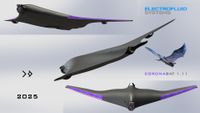
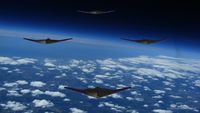
For this purpose, the new vehicle uses the more powerful 1024-core NVIDIA AI computer Jetson Orin NX 16GB with six 220 degree fisheye navigation cameras based on Sony IMX 586 (686/786) image sensors with 48mp (64/108mp) to capture 360 degree videos with ultrazoom function.
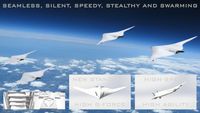
A swarm of four vehicles with a three wingspan distance in diamond formation has about 50% less total drag. So all following vehicles have a longer range. By repeated change of the lead position the range of all vehicles can be similarly extended. In a V-type formation with three vehicles the overall drag reduces by 35% followed by an echelon formation with two vehicles with about 25% drag reduction.
It is not widely known that bats keep the world record for the fastest level flight speed in the animal world. Brazilian free-tailed bats can reach 100 mph (160 km/h) in level flight. And this makes them faster than any bird on earth.
Bird-hunting peregrine falcons are the masters or titans of the sky. They just kick their preys out of the sky with a slashing blow from their powerful feets. And they can reach speeds of up to 242 mph (389 km/h) when diving but are much slower in level or horizontal flight.
Then, peregrine falcons can be even outflown by ordinary pigeons which can reach speeds of up to 92 mph (148 km/h) in level flight. And today, most of our mini and even small tactical UAVs are much slower than pigeons.
So we need a paradigm shift and have to apply new flight control techniques and advanced aircraft designs. Bats and birds can flap and morph their wings. We cannot do so easily. And when we do, our drones are still slow flyers. But what we can already do is active flow control by flapping plasma fields.
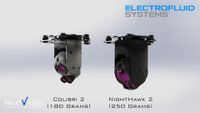
To have a precise bird-like view, Electrofluidsystems selected the world's most advanced mini dual electro-optical/infrared (EO-IR) stabilized NextVision cameras Colibri 2 and NightHawk2 for use in nose section and underbody.
There are four pre-serial prototypes for the PLASMA FALCON class with cruise speeds of ... mph and a maximum flight endurance of ... minutes. The 6.6 - 7.0 kg system has an endurance of up to ... minutes and a range of ... km (... miles).
The 8.0 kg eVTOL version has an endurance of up to ... minutes and a range of ... km (... miles) at ... km/h (... mph) cruise speed. The next bigger version PLASMA FALCON 1.66 will use a 800 W fuel cell module from Intelligent Energy and have an extraordinary flight range of up to ... km.
TECHNICAL SPECIFICATIONS
CoronaBat 1.11 Interceptor | CoronaBat 1.11 Intelligence | CoronaBat 1.11 VTOL Intelligence | CoronaBat 1.66 VTOL Intelligence | |
Length: | 0.84 m | 0.84 m | 0.85 m | 1.17 m |
Wingspan: | 1.11 m | 1.11 m | 1.11 m | 1.66 m |
Maximum Take-off Weight: | 6.6 kg | 7.0 kg | 8.0 kg | 13.0 kg |
Empty Weight: | ... kg | ... kg | ... kg | ... kg |
Battery Weight: | ... (...) kg | ... kg | ... kg | ... kg |
Fuel Cell System (FSC) Weight: | - | - | - | 2.8 kg 800 W FSC from IE with 2 liters H2 (706 Wh) or 1.5 liters LH2 (1673 Wh) |
Payload Weight: | ... (...) kg | ... kg | ... kg | ... kg |
Cruise Speed: | ... km/h (... mph) | ... km/h (... mph) | ... km/h (... mph) | ... kmh (... mph) |
Maximum Cruise Speed: | ... km/h (... mph) with ... propeller ... km/h (... mph) with 12x8 or 14x7 propeller | ... km/h (... mph) with ... propeller ... km/h (... mph) with 12x8 or 14x7 propeller | ... km/h (... mph) with ... propeller ... km/h (... mph) with 12x8 or 14x7 propeller | ... km/h (... mph) |
Flight Range: | ... km at ... km/h (... km with solar cells) | ... km at ... km/h (... km with solar cells) | ... km at ... km/h (... km with solar cells) | ... km (H2) ... km (LH2) (... km (H2) / ... km (LH2) with solar cells) |
Flight Time: | ... min. at ... km/h (... min with solar cells) |
... min. at ... km/h (... min with solar cells) | ... min at ... km/h with 2 min VTOL (... min with solar cells) | ... min (H2) at ... km/h with 3 min VTOL ... min (LH2) at ... km/h with 3 min VTOL (... min (H2) / ... min (LH2) with solar cells) |
Flight Altitude: | 0 - 8,500 m | 0 - 8,500 m | 0 - 5,500 m | 0 - 5,500 m |
Total Energy: | max. ... Wh (... Wh with solar cells) + ... Wh for plasma system and pitot tube heating | max. ... Wh (... Wh with solar cells) + ... Wh for plasma system and pitot tube heating | max. ... Wh (... Wh with solar cells) + ... Wh for plasma system and pitot tube heating | 706 Wh (H2) 1,673 Wh (LH2) (760 Wh (H2) / 1727 Wh (LH2) with solar cells) |
Specific Energy: | ... Wh/kg (LiPo) | ...Wh/kg (LiPo) | ... Wh/kg (LiPo) | ... Wh/kg (H2 + LiPo) ... Wh/kg (LH2 + LiPo) |
VTOL Power: | - | - | ... W | ... W |
Cruise Power: | ... W | ... W | ... W | ... W |
First Flight: | 2025 | 2026 | 2026 | 2026 |
Electric Motor: | Brushless (... + W) with or Brushless (... W) with ... or 12x8 or 14x7x3 propeller | Brushless (...+ W) with or Brushless (... W) with ... or 12x8 or 14x7x3 propeller | Brushless (-...+ W) with or Brushless (... W) with ... or 12x8 or 14x7x3 propeller | Brushless (... W) with ... propeller |
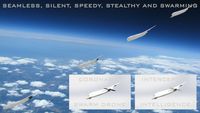
With CoronaBat UAS Electrofluidsystems redefines the next generation of swarm-capable, highly maneurable, high-speed mini UAV systems for real-time surveillance assisted by an AES-256 encrypted dual video telemetry system and the Mesh Rider Dual Radio from Doodle Labs with a handheld high-end GCS controller based on the ruggedized and robust Panasonic FZ-S1.
The CoronaBat UAV system has two onboard DroneCore2 modules from Airvolute with the latest NVIDIA AI computer Jetson Orin NX. The main autopilot is based on the US-made hardware Cube Blue with ADS-B antenna from CubePilot with two additional Cube Blue units on the DroneCore2 modules for triple autopilot redundancy.
The Cube Blue is identical to the Cube Orange with the main difference being that it is manufactured in the USA. The Cube Blue is designed for operators that require a US-made flight controller option, such as government or military operators.
One of the two AI-computers is reserved for the SWARMPILOT with six navigation cameras and the optional blockchain platform SWARMCHAIN for more secure communication and coordination of swarming unmanned aerial vehicles (SUAVs).
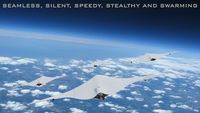
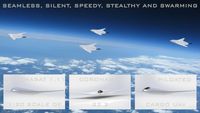
Electrofluidsystems CoronaBat 1.11 with its huge payload bay is also a 1:20 (CoronaBat 22.2) and 1:27 (CoronaBat 30.0) scale model for a new generation of flying wing cargo aircrafts with ultra-efficient 550 PS RED AIRCRAFT A03 Diesel engines which can be also modified to work with hydrogen fuel using plasma combustion systems. The standard A03 high-altitude engine with 500 PS can provides 375 PS at 35,000 ft (10,668 m).
At 45,000 ft (13,716 m) altitude, the CoronaBat 22.2 needs 460 PS to fly with a speed of 400 km/h. Otto Aviation uses advanced multi-stage turbo chargers and heat exchangers in the Celera 500L to compensate the dramatic power drop at altitudes from 10,668 m to 15,000 m where the standard engine only provides 170 PS (see for the US patent 9,446,835 B2 from William Otto).
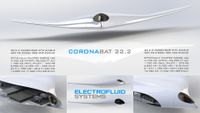
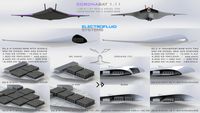
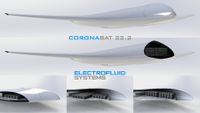
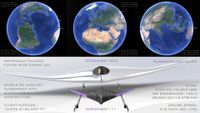
The payload bay of both versions can be easily accessed through the front door and in case of the bigger 8,600 kg variant with 30.0 m span can carry different standard cargo containers like LD-1, LD-2 or LD-3 and also different bulk cargo packages on 463L master pallets (HCU-6/E) as shown in the concept visualization above. The CoronaBat 30.0 will have a rear clamshell door to release airdrop pallets.
Electrofluidsystems optionally piloted flying wing cargo UAV CoronaBat 22.2 can also fly with sustainable aviation fuel-powered GE Catalyst turboprop engines and reach a constant cruise speed of 507 km/h (272 kts) at 13,176 m (45,000 ft) altitude. The same engine can also power the upscaled CoronaBat 30.0.
PLASMA (RAY) FLYER 1.11 / 11 - 18 kg MTOW
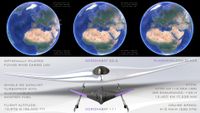
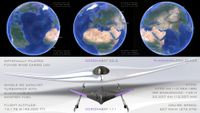
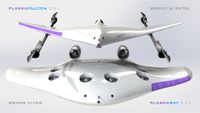
The stingray-shaped PLASMA RAY is an electric VTOL (eVTOL) UAV with 1.11 m wingspan and a maximum take-off weight (MTOW) of 11 - 18 kg. The deliverable payload weight is 4.0 - 8.2 kg. The near-term vision is to extend the product family to 1.66 m - 3.33 m wingspan until 2027. The AI swarm controller (SWARMPILOT) will enable coordinated flights in half-diamond and full diamond-shaped formations, reducing drag and increasing range by up to 50%.
The first pre-serial prototypes of the PlasmaRay with 1.11 m wingspan will use 12 electric ducted fan (EDF) jets from Schuebeler (DS-30-AXI HDS) and three kind of different brushless electric motors. There will be three basic versions for the PlasmaRay:
TECHNICAL SPECIFICATIONS
PLASMARAY 1.11 | H2PLASMARAY 1.11 | LH2PLASMARAY 1.11 | |
Length: | 0.78 m | 0.78 m | 0.78 m |
Wingspan: | 1.11 m | 1.11 m | 1.11 |
Maximum Take-off Weight: | 17.8 kg | 17.8 kg | 17.8 kg |
Empty Weight: | 5.4 kg | 5.8 kg | 5.8 kg |
Battery Weight: | 8.4 / 6.3 / 4.2 kg (4 / 3 / 2 x ...) | 2.2 kg (2 x ....) | 2.2 kg (2 x ...) |
Fuel Cell System (FCS) Weight: | - | 5.7 / 4.3 kg (2 x 800 W FCS from IE plus 4 liters H2) | 5.7 / 4.3 kg (2 x 800 W FCS from IE plus 3.0 / 1.5 liters LH2) |
Payload & Package Weight: | 4.0 / 6.1 / 8.2 kg | 4.1 / 5.5 kg | 4.1 / 5.5 kg |
Cruise Speed: | 233 - 266 km/h | 187 - 218 km/h | 187 - 218 km/h |
Maximum Cruise Speed: | 300+ km/h | 300+ km/h | 300+ km/h |
Flight Range: | 150+ / 110+ / 70+ km | 150+ / 70+ km | 340+ / 170+ km |
Flight Time | 40+ / 30+ / 20+ min (with 1 min VTOL) | 50+ / 25+ min (with 2 min VTOL) | 110+ / 55+ min (with 2 min VTOL) |
Flight Altitude: | 0 - 5,500 m | 0 - 5,500 m | 0 - 5,500 m |
Total Energy: | 1,704 / 1,278 / 852 Wh | 1,820 / 1,114 Wh | 3,753 / 2,080 Wh |
Specific Energy: | ... Wh/kg (LiPo) | ... Wh/kg (H2 + LiPo) | ... Wh/kg (LH2 + LiPo) |
VTOL Power: | 11,790 W | 11,790 W | 11,790 W |
Cruise Power: | 2,000 W | 1,600 W | 1,600 W |
First Flight: | 2026 | 2026 | 2026 |
Electric Ducted Fan (EDF) Motor: | 5+5+2 Schübeler DS-30-AXI HDS | 5+5+2 Schübeler DS-30-AXI HDS | 5+5+2 Schübeler DS-30-AXI HDS |

PLASMARAY 1.11 and H2PLASMARAY 1.11 UAV systems are plasma flow controlled, swarm capable eVTOL demonstrators for a new class of hydrogen fuel-cell powered, hyperfast air taxis with 6.66 m (900 - 1,000 kg), 8.88 m (1,850 - 2,000 kg), 11.1 (3,000 kg), 13.3 m (5,700 kg), 18.0 m (10,500 kg) and 19.9 m (13,500 kg) wingspan.
Electrofluidsystems also works on new heavy cargo BWB aircraft concepts based on the PlasmaRay design. A 4,700 kg PlasmaRay system would use 36 Vasyfan VF-570 lift fans (with each having 150 kg static thrust).
 |  |